

Most people who visit your website don’t buy or enquire on their first visit. They look around, get distracted, close the tab, and move on. Retargeting is how you bring them back.
It’s one of the most effective and cost-efficient advertising strategies available, and it’s massively underused by small and medium businesses in Australia. Here’s a clear explanation of what retargeting is, how it works, and what it can do for your business.
What retargeting actually is
Retargeting (also called remarketing) is a type of paid advertising that lets you show ads specifically to people who’ve already interacted with your business in some way, visited your website, watched one of your videos, engaged with your social content, or even opened one of your emails.
The idea is simple: instead of spending your whole ad budget trying to reach cold audiences who’ve never heard of you, you spend some of it going back to the people who’ve already shown interest. Those people are much more likely to convert because they already know who you are.
How retargeting works technically
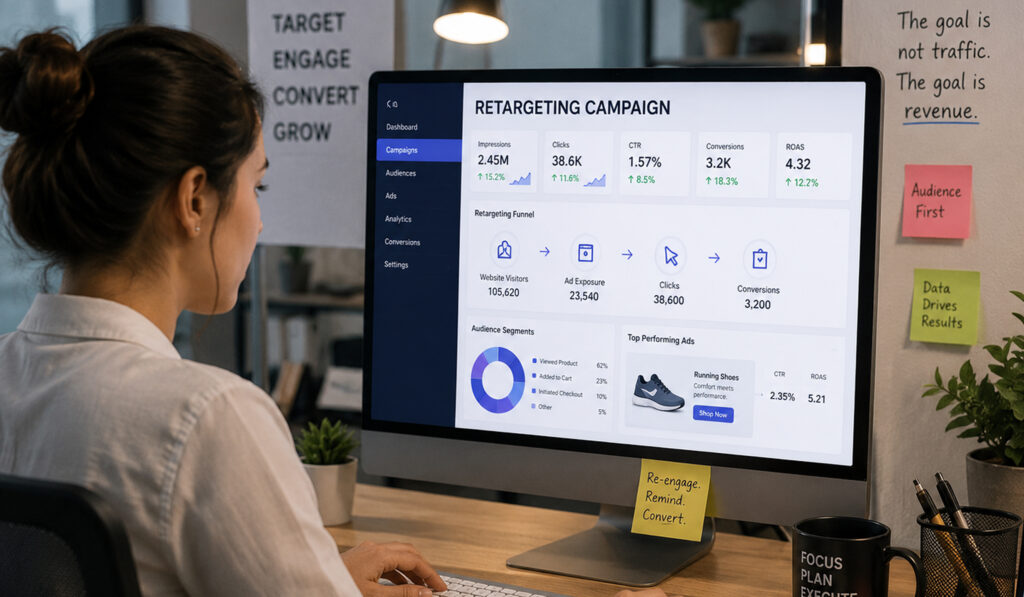
The most common way retargeting works is through a small piece of code called a tracking pixel, placed on your website. When someone visits your site, the pixel fires and records that visit. That person is then added to a custom audience list in your ad platform (Google, Meta, LinkedIn etc.), and you can start showing them ads across the web.
The ads follow them on Facebook, on Instagram, on YouTube, on news sites, across the Google Display Network, wherever the platform has ad inventory. To the user it can feel like your brand is “everywhere.” That’s retargeting working as intended.
For it to work, you need:
- A tracking pixel installed on your website (Meta Pixel, Google Tag, LinkedIn Insight Tag, etc.)
- A minimum amount of website traffic – usually at least 100 to 1,000 visitors per month before retargeting audiences are large enough to be useful
- An ad platform account to actually run the retargeting campaigns
Types of retargeting
Website retargeting – the most common type. Reach people who visited your website or specific pages. You can get granular here: target people who visited your pricing page but didn’t enquire, or people who started a checkout but didn’t complete it.
Video retargeting – reach people who watched a certain percentage of your videos on YouTube, Facebook or Instagram. Great for warming up audiences who’ve engaged with your content.
Social engagement retargeting – reach people who’ve liked, commented, shared or saved your social posts, even if they haven’t been to your website.
Email list retargeting – upload your email subscriber list to an ad platform and show ads to those people across social media and the web. Particularly useful for re-engaging cold subscribers.
Cross-platform retargeting – someone visits your website, gets added to your Google retargeting list and your Meta custom audience simultaneously, and then sees ads across both ecosystems. More touchpoints, more chances to convert.
Why retargeting works so well
A few reasons:
Intent signal. Someone who’s been to your website or engaged with your content has already shown they’re interested. You’re not interrupting a cold audience, you’re following up with a warm one.
Lower cost. Retargeting audiences tend to have higher click-through rates and conversion rates than cold audiences, which often means a lower cost per lead or sale.
Shorter conversion path. People in a retargeting audience already know your brand. You don’t need to spend as much ad real estate on awareness – you can get straight to the offer or call to action.
Frequency without waste. You’re showing ads to a defined list of people rather than a broad audience, so your budget is concentrated on the most relevant group.
Common retargeting mistakes
Showing the same ad forever. If someone sees the exact same ad for three months, they’ll start ignoring it or get annoyed. Rotate creative regularly and set frequency caps.
Retargeting everyone equally. Not all website visitors are equal. Someone who spent four minutes on your pricing page is much more valuable to retarget than someone who bounced after two seconds. Segment your audiences accordingly.
Skipping exclusions. Exclude people who’ve already converted. There’s no point advertising to someone who just became a customer.
Starting without enough data. If your website gets 50 visitors a month, your retargeting audience will be too small to run effectively. Build your organic traffic first, or consider how to get more eyes on your content through other channels.
How we use retargeting at Media Sociale
We treat retargeting as a core part of almost every paid advertising strategy we run. It’s rarely the only thing we do – you still need cold audience campaigns to fill the top of the funnel, but it’s nearly always part of the mix.
We set up proper pixel tracking, build segmented retargeting audiences, create specific ad creative for each audience segment, and set appropriate frequency caps so your ads stay effective rather than becoming wallpaper.
If you want to know how retargeting could fit into your marketing, we’re happy to take a look at what you’ve got set up and where the gaps are.